
عملية حفر القرص الصلب الخاص بك قد انتهت. لكن مشكلة سائل الحفر الخاصة بك ليست كذلك.
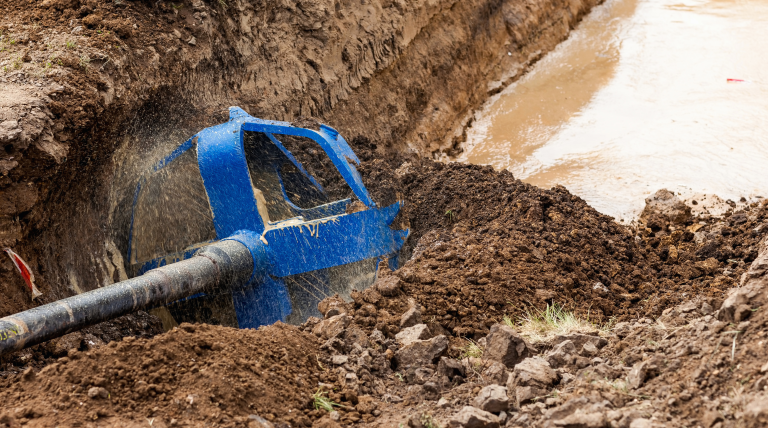
The bore is complete. The product pipe is in place. The drill string is out. The underground work is finished.
But there may still be hundreds of cubic metres of drilling fluid, wet spoils or slurry on the surface. Until that material is managed, the job is not really finished.
For HDD contractors, the work can continue long after the bore itself is complete: conditioning wet material, finding space to store it, bringing in dry soil or other bulking materials, loading trucks, transporting waste and meeting disposal requirements.
The drilling may have stopped. The material still needs to be managed.
Fluid Management Is Part of HDD Productivity
HDD is designed around moving efficiently underground, and drilling fluid supports that process. Once it returns to the surface carrying excavated material, the question changes: what happens to it next?
Every handling step consumes resources: working space, equipment hours, labour, truck capacity and time.
That is why drilling-fluid management is not just a disposal issue. It is part of HDD productivity.
When Drying Time Becomes Project Time
Consider an HDD operation generating approximately 330 m³ of bentonite mud every week.
Its conventional process relied on dry soil and natural drying. Large volumes of soil had to be transported to the site, mixed with the mud and left to dry for 6 to 14 days, depending on the weather, before the material could be moved.
Drilling did not pause while the previous week’s mud was drying. The result was a backlog of approximately 470 m³ occupying space on site at the same time.
When an alternative solidification process was introduced, freshly generated material reached a condition suitable for loading and transportation in under 30 minutes. This cleared the accumulated backlog, eliminated the ongoing need to transport outside soil to the site and brought material management into line with the rate at which the operation generated waste.
The problem was not simply wet mud. It was a material-management process that could not keep pace with the drilling operation.
Site Space Is an Operational Resource
Every cubic metre waiting to dry needs somewhere to go. When material remains on site for days while drilling continues, storage requirements build: more space, more handling and more equipment time before anything can be sent for disposal. This can restrict access, require additional equipment movements and limit how much material a site can generate before handling becomes the bottleneck.
This matters particularly on urban projects, road crossings, utility installations and other HDD work where space is already limited.
One HDD project illustrates the wider logistics challenge. It generated substantial volumes of liquid HDD waste in a densely populated urban environment, where transportation added cost and disruption. On-site solidification changed the material’s physical condition and reduced the need to transport it in liquid form. Documented results included disposal costs more than 30% lower and a 67% reduction in greenhouse gas emissions associated with transportation.
These are project-specific results, not universal performance claims. The same qualification applies to every figure in this article.
No Two HDD Slurries Are the Same
Moisture content, soil and rock composition, drilling-fluid characteristics and site conditions all affect how a slurry can be managed.
In another field application, HDD slurry had a variable moisture content of 40% to 70%, with approximately 6.5 m³ generated per day. The conventional process added 100–200% dry soil and allowed the material to dry for up to six days before disposal. Instead, a solidification reagent was incorporated directly into the slurry using the excavator already on site. The dosage was adjusted to the moisture content, and the material solidified in up to 30 minutes. The change was associated with estimated cost savings of 45% compared with the previous process.
Three projects, three different material-management problems. That is why dosage and treatment strategy should be based on the material and operating conditions, not a universal application rate.
Solidification as Part of the Workflow
MetaFLO has more than 20 years of experience developing solidification technologies for wet, difficult-to-handle materials. In HDD applications, that experience points to one principle: start with the material, not a fixed product or dosage.
A solidification reagent is incorporated into the wet material to control free water and change its physical characteristics. This can improve stability, reduce flowability and prepare the material for handling, transportation or disposal, depending on the application. For high-moisture applications, solidification reagents are designed for materials with approximately 30% to 80%+ moisture content, with reference dosages ranging from 0.1% to 0.70%. Final dosage and set time are confirmed through material-specific testing.
Solidification does not automatically change a material’s regulatory classification, guarantee acceptance at a disposal facility or make contaminated material clean. Those requirements still depend on material characterization, applicable regulations and receiving-site criteria.
When Is the Job Actually Finished?
HDD performance is usually discussed in terms of the bore: production rates, accuracy, drilling conditions and tooling. There is another measure worth tracking:
How long does it take to finish managing the material the bore generates?
Measure the time between the end of drilling and the point at which the material is ready for its next stage. Then look at what drives that interval:
- conditioning time
- volume generated per day or week
- temporary storage requirements
- dry soil or bulking-material consumption
- equipment hours and truck movements
- transportation distance and disposal requirements
That interval is part of the job, too. It can reveal a bottleneck that begins after the underground work is already complete.
Have an HDD slurry or wet-spoils application slowing down your operation? Send us a sample.
MetaFLO’s technical team can evaluate the material and help determine the appropriate solidification approach and dosage for your project.
Call us for a sample: 1-888-862-4011
[email protected]
metaflotech.com
 English
  Português do Brasil
  Español
  العربية
  Français
  Italiano