
Tunnel Spoil Management: How Solidification Reagents Support Sustainable EPB-TBM Operations

The Hidden Sustainability Challenge in Tunneling
As tunneling projects expand across transportation, mining, water, and utility infrastructure, sustainability is becoming a key project requirement. While modern EPB-TBM and slurry tunneling technologies have improved excavation efficiency, managing the large volumes of spoil generated during construction remains one of the industry’s biggest operational and environmental challenges.
Tunnel spoil often contains groundwater, conditioning foam, bentonite, and excavated soil. In many cases, the material behaves more like a liquid than a solid, making transportation, storage, and disposal difficult and costly.
Why Traditional Spoil Management Methods Fall Short
Contractors have traditionally relied on mechanical dewatering systems, lime stabilization, cement treatment, drying beds, or bulking agents to improve spoil handling. Although these methods can be effective, they often require additional equipment, larger site footprints, multiple handling stages, and increased labor.
Many traditional approaches also increase the volume of material requiring disposal, creating additional transportation costs and environmental impacts.
How Solidification Reagents Improve Tunnel Spoil Management
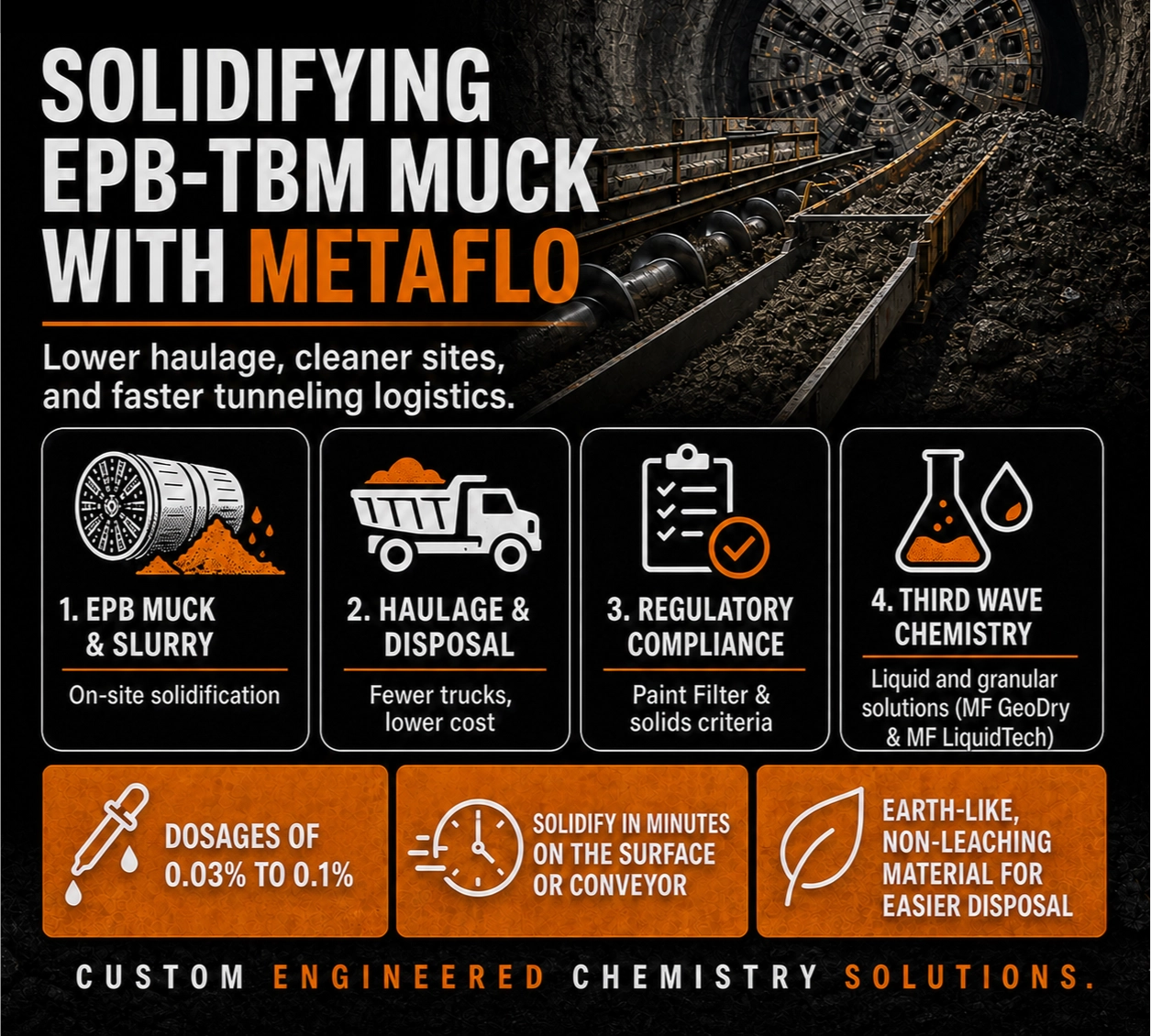
Solidification reagents provide a faster and more efficient approach to tunnel spoil treatment. By binding free water and modifying the physical characteristics of the material, these technologies transform wet, flowable spoil into stable, non-flowable, and often stackable material.
The result is improved handling, safer transportation, simplified disposal, and reduced operational disruption. Because modern solidification reagents typically require low dosage rates, contractors can achieve significant results without introducing large quantities of additional material into the waste stream.
Reducing Transportation Costs and Environmental Impact
Transportation is one of the largest contributors to the environmental footprint of tunneling projects. High-moisture spoil reduces truck payload efficiency and often requires additional trips to disposal sites.
By treating spoil at the source, solidification reagents help reduce truck movements, fuel consumption, greenhouse gas emissions, traffic congestion, and disposal costs. For project owners seeking both operational and environmental improvements, spoil solidification offers measurable benefits throughout the project lifecycle.
Supporting Sustainable Tunneling and ESG Objectives
Environmental, Social, and Governance (ESG) goals are increasingly influencing infrastructure development worldwide. Public agencies, contractors, and project owners are under growing pressure to reduce emissions, improve waste management practices, and demonstrate environmental responsibility.
Solidification technologies support these objectives by improving excavation waste management, minimizing environmental risks, reducing transportation-related emissions, and enhancing overall site efficiency. As sustainability requirements continue to evolve, effective spoil treatment is becoming an essential component of responsible tunneling operations.
How MetaFLO Helps Contractors Optimize Spoil Treatment
MetaFLO Technologies has developed a range of advanced solidification solutions specifically engineered for EPB-TBM and tunneling applications. Designed to address varying geological conditions, moisture levels, and project requirements, MetaFLO’s technologies help contractors convert difficult-to-manage spoil into stable, transportable material.
MetaFLO’s portfolio includes powder-based reagents, liquid injection technologies, biodegradable formulations, and customized solutions tailored to specific project conditions.
Key benefits include:
-
- Rapid spoil stabilization and stackability
- متطلبات الجرعة المنخفضة
- Reduced transportation and disposal costs
- Compatibility with existing site equipment
- تحسين الكفاءة التشغيلية
- Biodegradable options for environmentally sensitive projects
- Customized formulations based on geology and moisture content
By integrating spoil treatment directly into project workflows, contractors can improve productivity while advancing sustainability goals.
The Future of Sustainable Tunnel Spoil Management
As underground infrastructure projects continue to grow in scale and complexity, efficient spoil management will become increasingly important. Contractors are seeking solutions that not only improve operations but also help meet environmental targets and reduce project costs.
Solidification reagents are emerging as one of the most practical and scalable technologies available for sustainable tunneling. By transforming excavation waste into manageable material, they enable safer handling, lower emissions, and more efficient project execution.
Ready to Improve Your Tunnel Spoil Management Strategy?
Whether you’re planning a new EPB-TBM project or looking to optimize an existing operation, MetaFLO can help identify the right solidification solution for your geology, moisture conditions, and disposal objectives.
Contact the MetaFLO team today to learn how advanced solidification reagents can improve spoil management, reduce environmental impact, and support the success of your next tunneling project.
 English
  Português do Brasil
  Español
  العربية
  Français
  Italiano