
Sandy Soil Stabilization for Forestry Roads: Performance Under Traffic Loads of Up to 250 Tonnes
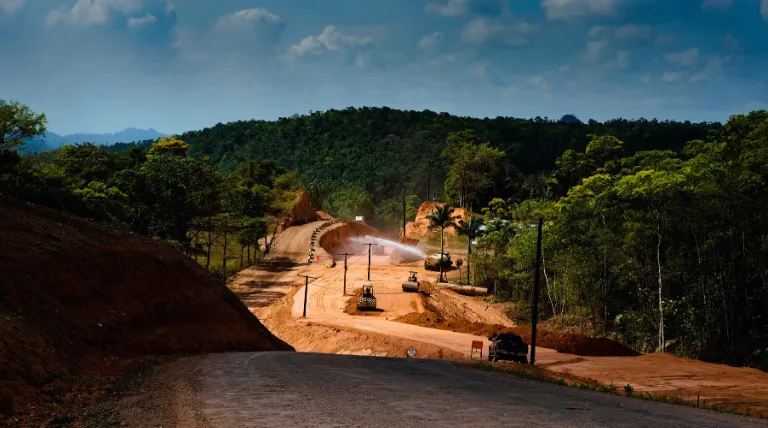
Forestry roads are among the most demanding components of the wood and pulp industry’s transportation infrastructure. Subjected to daily heavy vehicle traffic, these roads must maintain reliable operating conditions, even in areas with low-bearing-capacity soils and seasonal weather patterns alternating between dry periods and heavy rainfall.
When road structures cannot withstand these conditions, problems such as bogging, corrugation, erosion, and rutting can develop. Beyond affecting road accessibility, these issues require frequent maintenance and increase the complexity of logistics operations.
In this context, soil stabilization plays an important role in improving the structural performance and durability of unpaved roads.
To evaluate an alternative technology for these conditions, MetaFLO Technologies partnered with a pulp producer to study the application of its SoilTech biopolymer on a forestry road.
The project combined laboratory testing conducted by the Transportation Laboratory at the Federal University of Mato Grosso do Sul (LATRAN/UFMS) with 12 months of monitoring on a field trial section.
The results demonstrated substantial improvements in bearing capacity and the preservation of the stabilized layer’s structural integrity under actual operating conditions.
The Challenge: Supporting 250-Tonne Truck Configurations on Sandy Soil
Forestry operations require road infrastructure capable of supporting exceptionally heavy transport configurations. On the evaluated section, 21-axle trucks operated with a Gross Combination Weight (GCW) of up to 250 tonnes, carrying approximately 192 tonnes of eucalyptus timber payload. Axle loads exceeded 13 tonnes.
The challenge was further compounded by the characteristics of the local soil. Classified by Brazil’s National Department of Transport Infrastructure (DNIT) as tropical fine sand, the material was also non-plastic (PI = NP), indicating low natural cohesion.
In laboratory testing conducted by LATRAN/UFMS using modified compaction effort, the natural soil recorded a California Bearing Ratio (CBR) of 38.8%. This value served as the baseline for evaluating the performance of the different stabilization mixtures.
Under repeated heavy vehicle traffic, these soil characteristics contributed to deformation and increased road maintenance requirements.
SoilTech: A Seaweed-Based Biopolymer for Soil Stabilization
To address this challenge, تكنولوجيا التربة was selected as a seaweed-based biopolymer developed to improve the properties of soils used in infrastructure construction.
The technology promotes soil particle binding, increasing cohesion between particles and improving the mechanical behaviour of the stabilized material.
SoilTech is applied at low dosages, with field application rates ranging from 0.01% to 0.03% by dry soil mass.
Another important advantage is its compatibility with conventional road construction equipment. The product can be incorporated using water trucks, soil recyclers or agricultural disc harrows, motor graders, and compactors.
This allows SoilTech to be integrated into conventional road construction processes without requiring specialized equipment.
Laboratory Validation: SoilTech and Cement Combination Achieves a CBR of 207.1%
The mechanical performance of the mixtures was evaluated by the Transportation Laboratory at the Federal University of Mato Grosso do Sul (LATRAN/UFMS).
Testing was conducted using modified compaction effort, comparing natural soil with different chemical and granular stabilization alternatives.
Among the evaluated mixtures, the combination of 2% CP II cement and 0.2% SoilTech achieved the highest California Bearing Ratio (CBR): 207.1%.

Source: LATRAN/UFMS laboratory testing using modified compaction effort.
In addition to achieving the highest CBR, the cement and SoilTech mixture recorded an optimum moisture content of 5.8%, compared with 9.2% for the cement-only mixture.
These findings demonstrate the potential of this combination to improve soil bearing capacity and modify its compaction characteristics.
It is important to note that laboratory results reflect specific testing conditions and should not be confused with the performance subsequently observed in the field trial section.
From Laboratory to Field: 12 Months of Performance Under Heavy Traffic
Based on the technical evaluations, a field trial section was constructed using the following composition:
- 70% natural soil (sandy, A-2-4 classification);
- 30% graded crushed stone (BGS);
- 0.02% SoilTech;
- 2% CP II cement.
The section was monitored for 12 months to assess its performance under continuous 21-axle truck traffic and varying regional weather conditions.
Monitoring observations over time:
1 month: Road surface conditions remained satisfactory, with no plastic deformation or rutting.
5 months: The stabilized layer maintained its structural integrity, even under wet conditions and axle loads exceeding 13 tonnes.
9 months: During the heavy rainfall season, with continuous timber transport from two forestry properties, the stabilized section maintained surface cohesion, unlike surrounding untreated roads.
12 months: After one year of operation, the first localized corrective maintenance was performed, consisting of minor pothole repairs.
The monitoring period demonstrated the stabilized layer’s ability to maintain its performance under varying operating conditions, including periods of increased moisture and intensive heavy vehicle traffic.
An Alternative for Forestry Infrastructure Challenges
The study demonstrates how biopolymer-based soil stabilization can contribute to improving the performance of unpaved roads exposed to demanding operating conditions.
The combination of laboratory results and field monitoring demonstrated substantial improvements in bearing capacity, preservation of structural integrity over 12 months, and positive indicators of construction efficiency.
In forestry operations, where continuous heavy vehicle traffic demands durable and reliable infrastructure, selecting the appropriate stabilization technology requires consideration of soil characteristics, traffic loads, and regional climatic conditions. This assessment makes it possible to develop tailored solutions suited to the material properties and specific requirements of each project.
With SoilTech, MetaFLO develops solutions designed to improve soil performance and support operational efficiency in infrastructure projects.
Is your operation facing challenges with unpaved roads and heavy vehicle traffic?
Contact MetaFLO’s technical team to explore how SoilTech can be applied to your project.
 English
 Português do Brasil
 Español
 العربية
 Français
 Italiano