
A Terceira Onda de Solidificação para Gerenciamento de Detritos de Túnel
Profissionais de construção que trabalham em tunelamento mecanizado entendem uma realidade operacional fundamental: as condições do solo podem variar significativamente de um projeto para outro, e muitas vezes dentro do mesmo alinhamento de túnel.
Em ambientes urbanos complexos, especialmente em Construção de túnel de metrô, essas variações demandam constante adaptação técnica e controle preciso do material escavado desde o momento em que ele deixa a frente de corte.
Um dos desafios mais subestimados em operações de tunelamento mecanizado é o gerenciamento de detritos escavados e lama.
Projetos usando EPB TBMs, TBMs de lama, sistemas HDD e tecnologias de perfuração relacionadas geram grandes volumes de material úmido que devem ser manuseados, transportados, tratados e descartados de forma eficiente e em conformidade com as regulamentações aplicáveis.
Para projetos modernos de infraestrutura subterrânea, gerenciamento de detritos de túnel evoluiu de uma questão básica de gestão de resíduos para um componente estratégico da execução de projetos.
O que é Solidificação de Detritos de Túneis?
Solidificação de rejeito de túnel é o processo de tratamento químico de material úmido escavado de operações de TBM ou HDD para reduzir o teor de água livre, melhorar a estabilidade estrutural e permitir um transporte e descarte mais seguros.
Agentes de solidificação ligam o excesso de umidade na matriz do rejeito, convertendo rejeitos líquidos ou semilíquidos em um material estável e empilhável, adequado para transporte e descarte.
O transporte de detritos com excesso de água livre aumenta o peso do transporte, eleva os custos de transporte e, em muitas jurisdições, cria exposição à conformidade sob regulamentações ambientais para descarte de resíduos de tunelamento.
Armazenar lodo úmido no local enquanto se aguarda a evaporação natural raramente é prático em ambientes de construção urbanos densos.
Grandes estoques ocupam espaço de trabalho crítico, atrapalham a logística do local e impactam diretamente o desempenho do cronograma e dos custos, dois dos indicadores mais monitorados na entrega de infraestrutura.
EPB TBM vs Slurry TBM Requisitos de Tratamento
Nem todo material escavado se comporta da mesma forma, e o método de escavação é um dos fatores mais significativos a determinar o tipo de tratamento de solidificação necessário.
EPB TBM resíduos normalmente contém solo condicionado misturado com espuma e água, resultando em um material plástico e coesivo que requer redução de umidade para um transporte seguro e eficiente.
O desafio é reduzir o teor de água livre, preservando as características de manuseio que permitem o carregamento e transporte mecânicos.
Batelada de solo de TBM de lama é uma suspensão com alto teor de água que geralmente requer separação e desaguamento antes que o tratamento de solidificação possa ser aplicado de forma eficaz.
A química da polpa, incluindo o teor de bentonita, sólidos suspensos e pH, influencia diretamente a seleção e a estratégia de aplicação dos reagentes.
A seleção e a dosagem dos reagentes diferem significativamente entre os dois modos de escavação e devem levar em conta a geologia, os aditivos introduzidos durante a escavação e os requisitos de descarte final.
Uma abordagem de tratamento projetada para condições de EPB não se traduzirá necessariamente para operações de TBM de lama, e vice-versa.
Três Fases da Tecnologia de Solidificação de Detritos de Túnel
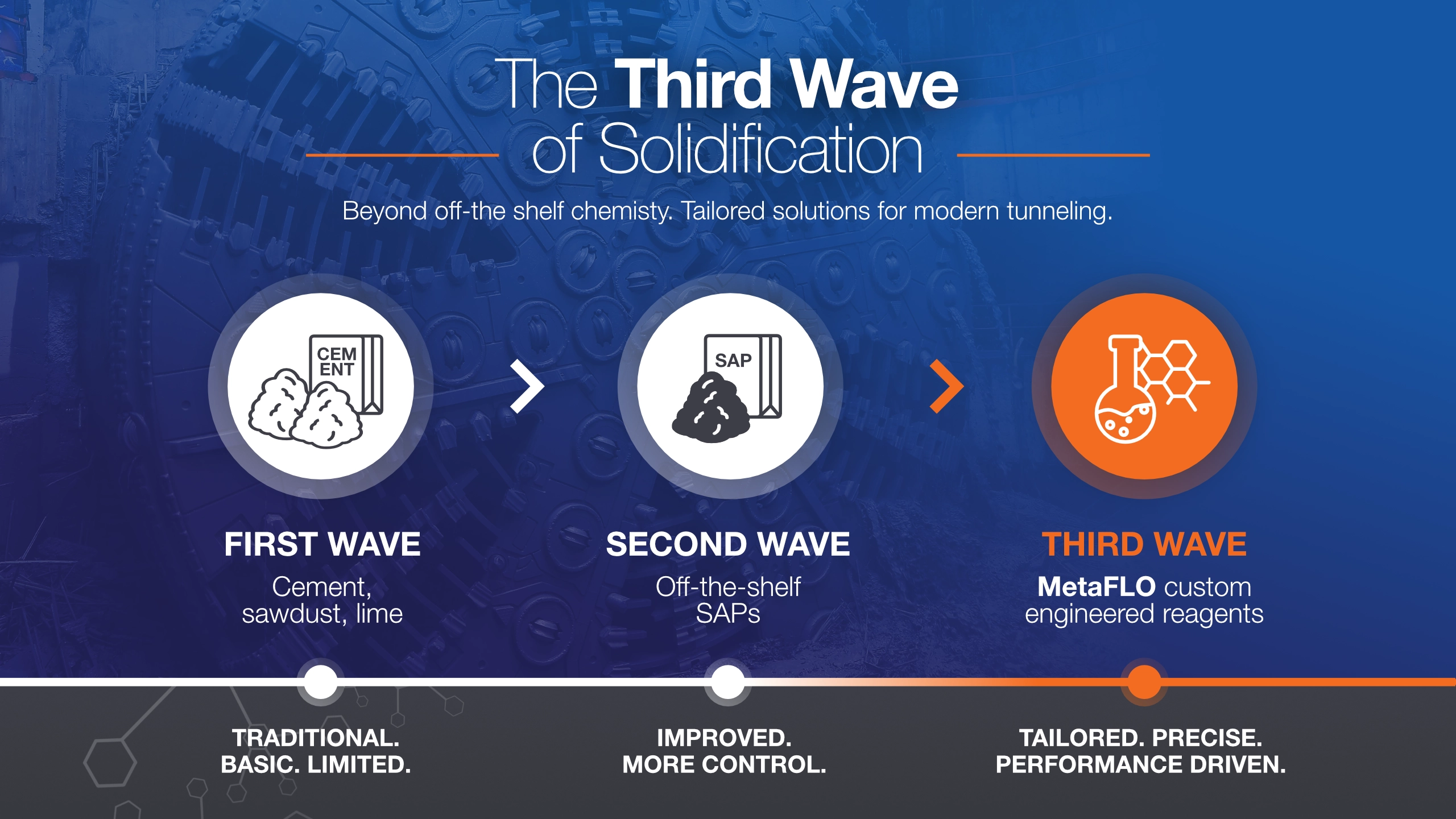
A MetaFLO identifica três fases distintas na evolução da tecnologia de solidificação para gerenciamento de resíduos de tunelamento e perfuração.
Primeira Onda: Cimento, Cal e Aglutinantes Tradicionais
A Primeira Onda utilizou materiais de construção convencionais, como cimento, cal viva, hidróxido de cálcio e agentes de volume orgânicos, como serragem, para melhorar as características de manuseio de detritos úmidos.
Essas abordagens proporcionaram estabilização básica, mas exigiram altas taxas de aplicação e produziram resultados que variaram consideravelmente com as mudanças no tipo de solo, teor de umidade e mineralogia.
À medida que os projetos de tunelamento se tornavam mais complexos, as limitações desses métodos tradicionais tornaram-se cada vez mais evidentes.
Segunda Onda: Polímeros Superabsorventes (SAPs) e Absorventes Padronizados
A Segunda Onda introduziu comercialmente formulado Polímeros Superabsorventes (PSAs) e produtos de solidificação padronizados projetados especificamente para o tratamento de lodo e detritos em aplicações de tunelamento.
Comparadas às abordagens tradicionais, essas tecnologias melhoraram a eficiência de absorção e reduziram algumas das restrições operacionais associadas a agentes estabilizadores a granel.
No entanto, a maioria das soluções prontas ainda dependia de químicas genéricas aplicadas a condições subterrâneas altamente variáveis.
Agentes de Solidificação Orgânicos de Engenharia Baseados em SAPs
Polímeros Superabsorventes (PSAs) são polímeros sintéticos projetados para absorver e reter grandes volumes de água principalmente através de mecanismos de inchamento.
Seu desempenho é relativamente previsível sob condições controladas, mas pode se tornar inconsistente quando a química do solo, a mineralogia da argila ou a composição das águas subterrâneas saem dos parâmetros de projeto do produto.
Agentes de solidificação orgânicos de engenharia podem ser formulados para combinar com químicas específicas de aterro, mineralogias de argila, perfis de umidade e condições operacionais.
Isso permite um desempenho mais consistente em condições de solo variáveis, sem a sensibilidade à dosagem frequentemente associada aos SAPs em solos reativos ou de alta argila.
Por que Produtos Genéricos de Solidificação Frequentemente Têm Desempenho Inferior
A maioria dos produtos de solidificação disponíveis no mercado são tipicamente desenvolvidos com base em suposições de desempenho amplas, em vez das condições geoquímicas e operacionais específicas de projetos individuais.
A geologia muda de projeto para projeto e dentro do mesmo avanço de túnel.
A mineralogia da argila afeta o comportamento de ligação à umidade. A química das águas subterrâneas influencia o desempenho do reagente.
Quando as condições reais se desviam da linha de base assumida, o que é comum em tunelamento urbano através de geologia variável, produtos padronizados muitas vezes exigem dosagens mais altas, entregam resultados inconsistentes de redução de umidade e aumentam os custos gerais de tratamento de escavações.
No tunelamento, o desvio da linha de base é a norma, não a exceção.
A Terceira Onda da Solidificação
O Terceira Onda de Solidificação é a estrutura da MetaFLO para tratamento de detritos sob medida, onde reagentes personalizados e projetados são desenvolvidos em torno da geologia real, perfil de umidade, comportamento da argila e condições operacionais de cada projeto de tunelamento.
Em vez de aplicar a química genérica a ambientes subterrâneos altamente variáveis, a Terceira Onda começa com uma avaliação técnica das características reais do material escavado do projeto.
O desenvolvimento da formulação segue dessa análise, produzindo um reagente projetado para as condições que serão realmente encontradas durante a escavação.
Os fatores considerados durante o desenvolvimento da formulação incluem geologia e classificação do solo, mineralogia de argila e comportamento de inchaço, química da água subterrânea e pH, teor de água livre, variabilidade da composição do material ao longo do alinhamento, logística de transporte, requisitos de descarte e metas de produtividade operacional.
O que muda com o desenvolvimento de formulações personalizadas
Quando os reagentes de solidificação são combinados com as condições reais do solo, as melhorias operacionais se tornam mensuráveis em várias etapas das operações de tunelamento.
Eficiência em Transporte e Carga
Reduzir o teor de água livre em material escavado diminui diretamente a massa de carga.
Um menor peso de carga pode reduzir o consumo de combustível por ciclo, melhorar a produtividade dos caminhões e diminuir os custos gerais de transporte por metro cúbico de material removido.
Em projetos de túneis urbanos de alto volume, esses ganhos podem se acumular significativamente ao longo da duração do projeto.
Logística de Sítio e Gerenciamento de Espaço
O material escavado, estável e empilhável, reduz a área necessária para o armazenamento temporário no portal do túnel.
Em canteiros de obras urbanos com restrições, isso se traduz em mais espaço útil de trabalho, coordenação logística mais simples e menor interferência entre as atividades de manuseio de detritos e outras operações de construção.
Controle de Cronograma e Custo
Interrupções no manuseio de detritos são uma fonte comum, mas subnotificada, de variação no cronograma em projetos de túneis.
O desempenho inconsistente na solidificação cria gargalos na área de detritos, atrasa os ciclos operacionais da TBM e força intervenções reativas em campo.
Formulações personalizadas ajudam a reduzir essa variabilidade e a suportar taxas de avanço mais previsíveis.
Considerações Regulatórias para o Descarte de Resíduos de Túnel
Requisitos regulatórios para descarte de resíduos por tunelamento variam de jurisdição para jurisdição, mas muitas vezes compartilham áreas comuns de foco.
Muitas instalações de descarte proíbem materiais que contêm líquidos livres mensuráveis, tornando a redução eficaz da umidade um pré-requisito para o descarte em vez de uma conveniência operacional.
Os requisitos podem também abordar características do chorume, composição química de aditivos de escavação e classificação do material escavado como resíduo inerte, não perigoso ou perigoso.
A solidificação eficaz de rejeitos simplifica a documentação de conformidade e reduz o risco de eventos de não conformidade em instalações de descarte.
Para projetos que operam em múltiplos locais de descarte ou sob regulamentações ambientais em evolução, o desempenho consistente no tratamento de detritos/resíduos se torna cada vez mais valioso.
Suporte Técnico Contínuo Durante a Escavação
Ambientes de construção subterrânea são dinâmicos, e as condições do material escavado podem mudar consideravelmente à medida que a escavação avança através de diferentes unidades geológicas.
Uma formulação de reagente otimizada para uma seção do acionamento pode exigir ajuste à medida que as condições evoluem.
O modelo da Terceira Onda inclui colaboração técnica contínua entre especialistas da MetaFLO e equipes de engenharia de projeto ao longo da execução.
Isso permite que parâmetros de formulação, estratégias de dosagem e métodos de aplicação sejam ajustados de acordo com as observações de campo e as condições mutáveis do resíduo.
Integração de Materiais Disponíveis Localmente
Outra característica da abordagem da Terceira Onda é a integração de materiais disponíveis localmente ao lado das tecnologias proprietárias da MetaFLO.
Isso reduz a dependência de produtos de tratamento importados, encurta cadeias de suprimentos e melhora a resiliência logística, especialmente em grandes projetos de infraestrutura onde a disponibilidade de materiais pode afetar diretamente a continuidade operacional.
Gerenciamento de Detritos de Túnel como uma Disciplina Estratégica
À medida que os projetos de túneis e infraestrutura subterrânea continuam aumentando em escala e complexidade técnica, soluções para gerenciamento de detritos de túnel estão recebendo maior atenção por parte dos proprietários de projetos, empreiteiros e órgãos reguladores ambientais.
O gerenciamento eficiente de resíduos contribui para canteiros de obras mais limpos, menores impactos no transporte, melhores resultados de conformidade e reduções mensuráveis no custo total do projeto.
A evolução da tecnologia de solidificação reflete essa mudança.
A Primeira Onda abordou o manuseio básico.
A Segunda Onda melhorou a eficiência de absorção através de química padronizada.
A Terceira Onda introduz adaptabilidade projetada, formulações desenvolvidas em torno das condições reais de cada projeto em vez de aproximá-las.
Para equipes de tunelamento operando em geologia variável, ambientes urbanos restritos ou sob rigorosos requisitos ambientais, a diferença entre um produto genérico e um reagente customizado não é marginal.
Está operacional.
Saiba mais sobre nossas soluções: Reagentes de solidificação
 English
  Português do Brasil
  Español
  العربية
  Français
  Italiano