
Liquid Hauling, Bulking Agents or On-Site Solidification: Which Route Makes Sense for Your Project?
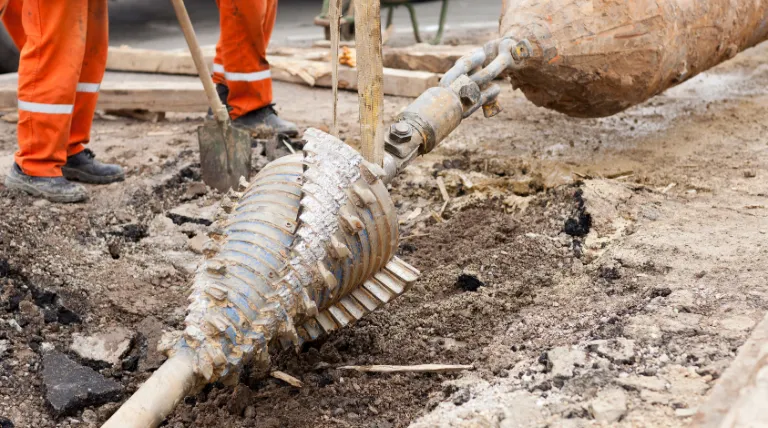
Excavation may be complete, but the material it generates still needs somewhere to go.
For hydro excavation, horizontal directional drilling (HDD) and tunneling contractors, managing wet spoils and slurry can become one of the most expensive and time-consuming parts of an operation.
High moisture content, limited storage space, transportation requirements and disposal restrictions can turn excavated material into a logistical bottleneck.
Contractors generally have three routes to consider: haul the material as a liquid, mix it with bulking agents or solidify it on-site.
The difference between these approaches goes far beyond the cost of processing the material. It affects how much volume must be transported, which trucks can be used and how quickly the operation can move forward.
Route 1: Liquid Hauling — Moving Water Comes at a Cost
The first option is to keep slurry in its liquid state and transport it using vacuum trucks or tankers to an authorized receiving facility.
This approach avoids the use of bulk treatment agents and lengthy drying times, but it creates a dependency on specialized transportation and facilities capable of accepting liquid waste.
For hydrovac contractors, this can be particularly challenging. Every trip to a disposal facility takes a truck away from excavation activities, potentially reducing fleet productivity.
Longer distances, unloading delays and liquid disposal fees can further increase operating costs.
HDD operations face similar challenges when residual drilling fluids cannot be recovered or recycled and must be transported off-site.
The main trade-off: Liquid hauling avoids additional material processing at the jobsite, but contractors may face higher transportation costs, specialized equipment requirements and limited disposal options.
Route 2: Bulking Agents — When More Material Means More Trucks
A conventional alternative is to mix slurry with dry soil, aggregates, sawdust or other bulking materials to reduce flowability and improve handling.
While this can make wet spoils easier to load and transport, the added material creates another problem: increased disposal volume.
Depending on the original material and the quantity of bulking agents required, the final volume can increase by 50% to as much as 300% in certain applications.
For a contractor managing 100 m³ of slurry, this could mean handling between 150 m³ and 400 m³ of material after bulking.
That additional volume has consequences throughout the operation:
- More material must be delivered to the jobsite.
- Additional mixing and handling may be required.
- More truckloads may be needed to remove the resulting material.
- Disposal charges may increase with the additional volume or weight.
Bulking agents may still be appropriate when materials are readily available and project conditions support their use. However, their purchase price alone rarely reflects the full cost of this approach.
The main trade-off: Bulking can improve material consistency, but the resulting volume increase may create additional transportation and disposal costs.
Route 3: On-Site Solidification — Change the Material, Not the Volume
On-site solidification takes a different approach.
Instead of adding large quantities of dry material, specialized reagents are mixed with slurry or wet spoils to control free water and improve their handling characteristics.
MetaFLO Technologies develops solidification reagents designed for different material compositions, moisture conditions and operational requirements.
Its portfolio includes conventional granular and powder reagents, formulations tailored to specific projects and regions, biodegradable options and liquid formulations for compatible applications.
Depending on the selected reagent and material characteristics, MetaFLO solutions can achieve a stackable, non-flowable consistency in 30 minutes or less, with reagent additions of less than 1%.
Unlike conventional bulking approaches, these low addition rates can keep the increase in material volume to approximately 1% or less, depending on the formulation and application.
For a project generating 100 m³ of slurry, this means the operation may be able to manage approximately the original material volume rather than significantly increasing it through bulking.
The operational advantages can include:
- Faster preparation for loading and transportation.
- Reduced dependence on specialized liquid hauling.
- Minimal additional volume requiring disposal.
- More efficient use of existing handling equipment.
- Greater flexibility in temporary storage and material management.
Solidification does not necessarily remove water from the material. Instead, the reagents modify how free water is retained, changing the material’s consistency and behavior during handling.
The objective is to achieve the physical characteristics required for the next stage of the operation, whether loading, temporary storage, transportation or disposal.
How the Three Routes Compare
| FACTOR | LIQUID HAULING | BULKING AGENTS | METAFLO SOLIDIFICATION |
|---|---|---|---|
| Material condition | Remains liquid | Modified by added dry material | Non-flowable or stackable |
| Additional volume | No bulking | Potentially +50% to +300% | Approximately 1% or less* |
| Processing time | No on-site solidification | Depends on material and mixing | As little as 30 minutes* |
| Transportation | Vacuum trucks or tankers | Potentially dump trucks | Potentially dump trucks |
| Main cost consideration | Specialized hauling and liquid disposal | Added material, volume and handling | Reagent, mixing and logistics |
| Disposal requirements | Liquid receiving facility | Acceptance of resulting material | Acceptance of resulting material |
*Performance depends on reagent selection, material characteristics, dosage, mixing conditions and project requirements. The ranges shown are application-dependent, not universal guarantees.
Where Does Solidification Fit in Hydro Excavation, HDD and Tunneling?
Although these industries generate different waste streams, they share a common challenge: wet material that may be difficult to store, handle or transport.
Hydro Excavation: Hydrovac slurry can require specialized disposal routes. Solidification may allow discharged material to be handled with conventional equipment and transported as non-flowable spoils, subject to receiving-facility requirements.
Horizontal Directional Drilling: After drilling fluid recovery or recycling, residual bentonite slurry and wet spoils may require further management. Solidification can reduce reliance on extended natural drying or large quantities of bulking materials.
Tunneling: EPB-TBM operations may generate conditioned muck that requires additional consistency control before loading or storage. In slurry TBM operations, solidification may be applied to residual wet solids after separation and processing.
In every application, the appropriate reagent and dosage depend on the material’s composition, moisture content, mixing conditions and desired end-state.
The Right Comparison Is Total Waste Management Cost
A lower disposal fee does not necessarily mean a lower overall cost.
Likewise, an inexpensive bulking agent can become costly when it increases the number of loads leaving the jobsite.
To compare the three routes, contractors should evaluate the complete operation:
Total Waste Management Cost = Material Processing + Equipment & Labor + Transportation + Disposal + Storage & Handling
The most economical strategy depends on factors such as disposal distance, truck availability, processing requirements and the amount of material ultimately transported.
For projects where hauling and disposal represent major expenses, reducing unnecessary material volume can have a meaningful impact on the overall budget.
However, any approach must also satisfy the receiving facility’s requirements.
In the United States, EPA Method 9095B (Paint Filter Liquids Test) may be used to assess the presence of free liquids in certain waste streams. Passing this test does not automatically establish that a material is nonhazardous or approved for disposal or beneficial reuse.
Waste characterization, local regulations and facility acceptance criteria remain essential considerations.
Choosing a Solidification Strategy That Fits the Project
With more than 20 years of experience in solidification technologies, MetaFLO Technologies supports contractors in evaluating material characteristics and identifying suitable reagent formulations.
Its solidification portfolio, including MF003, MF GeoDry, MF BioDry and MF LiquidTech, provides different options for specific handling requirements and field conditions.
The objective is not to apply the same reagent or dosage to every material. It is to identify a solution that achieves the required consistency while supporting efficient handling, transportation and disposal.
Ultimately, the right route is determined by more than how quickly slurry can be removed from a jobsite.
It is determined by how efficiently the material can reach its final destination, without unnecessary volume, handling or cost.
Planning Your Next Project?
Managing high-moisture spoils or slurry in hydro excavation, HDD or tunneling?
Talk to MetaFLO’s specialists about your material characteristics, solidification requirements and opportunities to improve handling and disposal logistics.
 English
 Português do Brasil
 Español
 العربية
 Français
 Italiano