MetaFLO Technologies · Réactifs de solidification
MF003 - Reagent for Liquid Waste and Sludge Solidification
An environmentally safe solidification reagent designed to simplify the handling, transport, and disposal of challenging liquid waste streams including EPB-TBM spoils, micro-tunneling slurry, water-based drilling fluids, sewage sludge, stormwater pond sediments, and hydro excavation mud.
En termes clairs
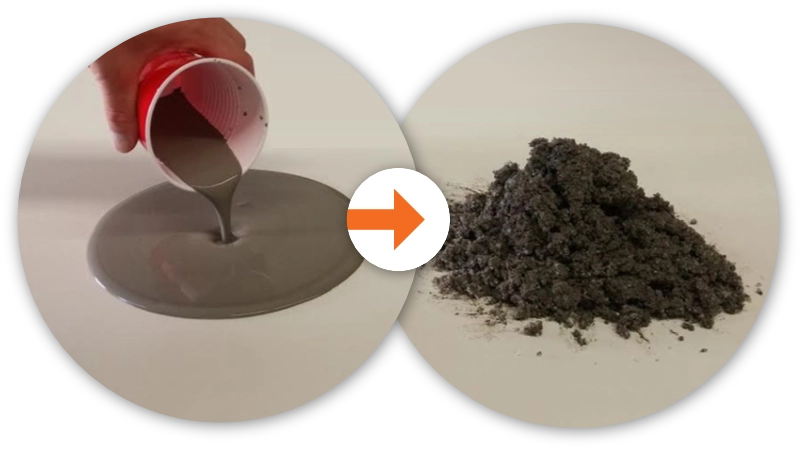
MF003 is a solidification reagent by MetaFLO Technologies that is applied directly into liquid waste streams to rapidly transform them into stackable solids for easier handling, transport, and disposal in less than 30 minutes. Designed for applications including micro-tunneling slurry, EPB-TBM spoils, water-based drilling fluids, sewage sludge, stormwater and wastewater pond sediments, and hydro excavation mud, MF003 helps simplify waste management operations while reducing free liquids and improving material handling conditions.
< 30min
Solidifier les déchets liquides
Jusqu'à 67%
Réduire les coûts logistiques d'élimination
Jusqu'à 30%
Réduire les coûts d'élimination
Low dosage application
What is MF003?
MF003 is a white granular solidification reagent designed to rapidly convert liquid and semi-liquid waste streams with variable solids content into a dry, granular solid with no free liquids. It is used to treat drilling mud, drilling sludge, tunneling spoils, TBM and EPB slurry, HDD drilling fluids, wastewater sludge, and other high-moisture residues.
The technology helps waste generators meet EPA Paint Filter Test criteria by transforming wet waste into a stackable, landfill-compatible material that is easier to handle, transport, stockpile, and dispose of.
MF003 delivers rapid in-situ solidification in less than 30 minutes, producing a stable granular residue with minimal sensitivity to ambient humidity. The technology has passed microtoxicity testing and is designed for tunneling, drilling, environmental, and wastewater treatment operations.
What problems does MF003 solve?
Managing liquid waste, drilling mud, sludge, and wet spoils from tunneling, drilling, wastewater operations, stormwater sediment removal, and hydro excavation activities is costly, logistically complex, and increasingly regulated. Conventional solidification methods such as lime, sawdust, drying pits, or evaporation ponds often increase waste mass, occupy valuable operational space, and delay disposal workflows. Inadequately treated waste can also release free liquids during handling and transport, creating operational challenges and disposal restrictions.
MF003 addresses these challenges from generation to final disposal. Applied at typical dosages ranging from 0.1–1.0%, MF003 rapidly transforms liquid and semi-liquid waste into a stackable material in under 30 minutes. The treated material reduces free liquid release and improves handling, transport, stockpiling, and disposal operations.
The result: simplified waste management operations, improved material handling conditions, approximately 30% lower disposal costs, and up to 67% lower logistics costs compared with conventional solidification methods.
How does MF003 work?
With low dosage rates typically ranging from 0.1–1.0% relative to waste mass, MF003 is applied directly onto wet material and mechanically mixed using excavators or similar equipment.
The reagent allows rapid solidification, transforming sludge, drilling fluids, slurry, wet spoils, and liquid waste streams into stackable material suitable for transportation and disposal operations.
MF003 creates a stable material that reduces free liquid release during handling and supports easier operational management of wet waste streams.
Before and After MF003 application
How does MF003 compare?
| Critères | Chaux (quicklime / chaux hydratée |
Ciment | Sciure | Mécanique séchage (centrifugeuses) |
Naturel séchage |
Géosacs | MF003 |
|---|---|---|---|---|---|---|---|
| Dosages | ~Posologie 5.0% | ~10.0% dosage | ~30,01 TP3T : posologie | — | — | — | 0.1–1.0% dosage |
| Facilité de manipulation ou de mélange | Bas | Bas | Haut | Moyen | Moyen | Moyen | Haut |
| Response speed until material stops leaching | environ 24 heures | 24 h | 24 h | Dépend de la centrifugeuse | Semaines | Semaines | <30 min |
| Gain de force physique | Limité | Haut | Aucun | Aucun | Aucun | Aucun | Pas l'objectif |
| Stabilité chimique dans le temps | Can leach | Variable | Bas | — | — | — | Haut |
| Réaction exothermique | Oui | Peut survenir | Non | Non | — | — | Ne génère pas |
| Réduction des coûts de transport | Moyen | Bas | Bas | Moyen | Moyen | Moyen | Réduction pouvant atteindre 671 TP3T |
| Réduction des coûts d'élimination | Moyen | Bas | Bas | Moyen | Moyen | Moyen | Réduction d'environ 30% |
| Classification as solid (non-leaching) | Pas toujours | Pas toujours | Pas toujours | Pas toujours | Non | Pas toujours | Conforme au test de filtration de peinture (EPA 9095) |
| Risque environnemental | Moyen / Élevé | Moyen / Élevé | Moyen | Moyen | Haut | Moyen | Bas |
How to apply MF003
1. Analyser les déchets
Evaluate the waste type, water content, density, and handling requirements to define the appropriate MF003 dosage. Typical application rates generally range from 0.1–1.0%.
2. Apply MF003 directly onto the wet material
Spread the reagent directly over sludge, drilling fluids, spoils, sediments, or liquid waste streams in pits, tanks, ponds, containers, stockpiles, or staging areas.
3. Mélanger mécaniquement le matériau
Mix using excavators or similar equipment to ensure uniform distribution and full contact between MF003 and the wet material.
4. Laisser solidifier
MF003 allows rapid solidification, transforming the waste into a stable and stackable material in less than 30 minutes.
5. Transporter, stocker ou éliminer
Once solidified, the material can be handled using conventional equipment for transportation, temporary stockpiling, or disposal operations.
Where MF003 is used
Featured Application
EPB TBM Tunneling: Proven for More Than 20 Years
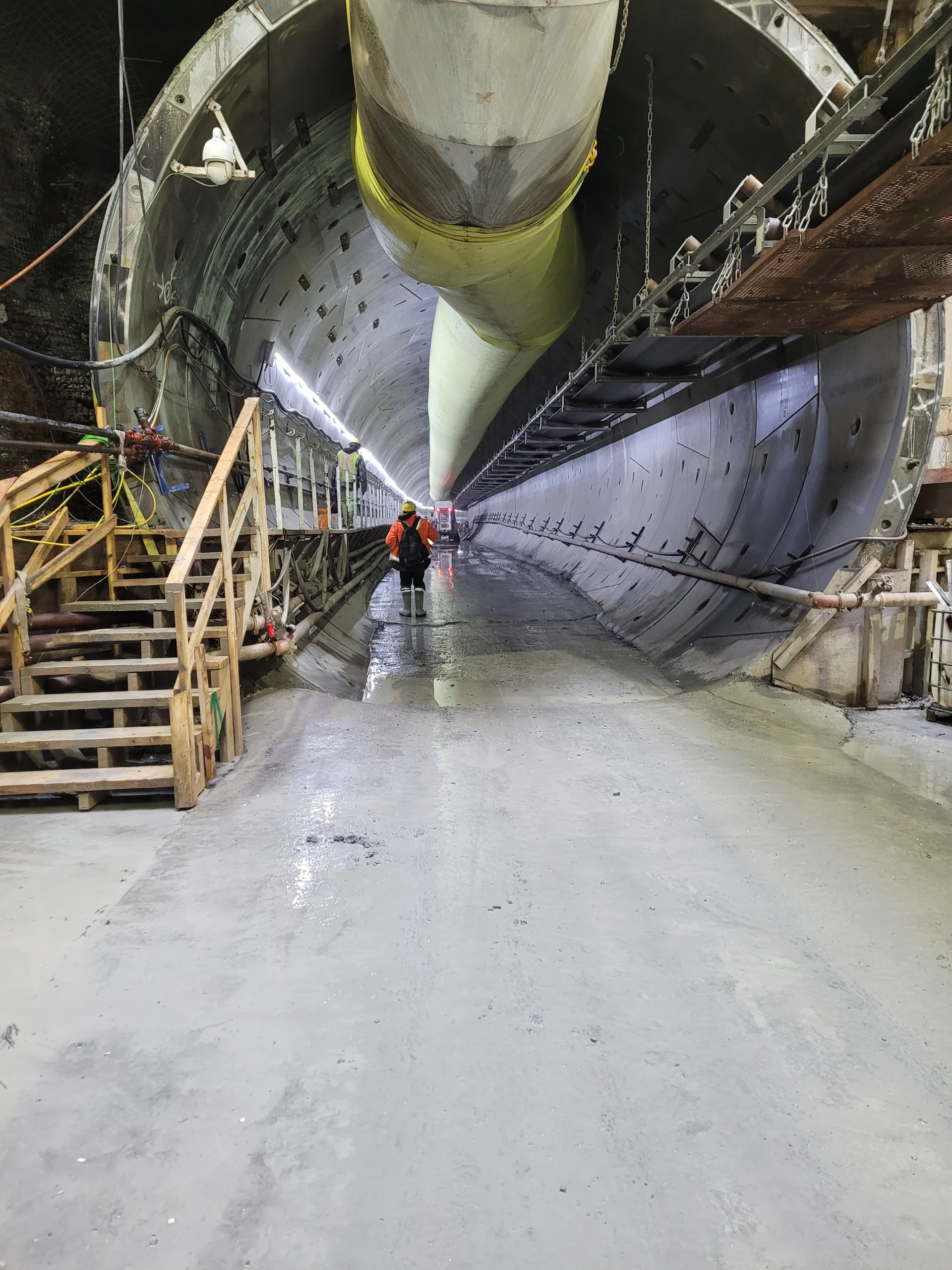
For more than two decades, MF003 has helped contractors manage conditioned EPB tunnel spoil across projects with varying geological conditions. Unlike conventional excavated soil, EPB spoil contains water and conditioning agents such as bentonite and foam, creating a high-moisture material that can be difficult to handle, transport, stockpile, and dispose of efficiently.
MF003 rapidly transforms conditioned tunnel spoil into stackable material by reducing free liquids, helping improve spoil handling, transportation, stockpiling, and disposal. By solidifying the muck, the reagent prevents downtime and supports continuous excavation while simplifying downstream waste management.
Explore MetaFLO's Complete EPB TBM Solution Portfolio
Alongside MF003, MetaFLO has developed additional tunneling technologies designed to address different geological conditions, moisture characteristics, and operational requirements throughout the spoil management process.
- MF BioDry™ – Biodegradable technology for EPB-TBM spoil solidification and environmentally responsible spoil management.
- MF GeoDry™ – Cost-optimized dry technology for EPB-TBM spoil solidification and free-water control.
- MF LiquidTech™ – Liquid-applied technology for EPB-TBM spoil solidification with enhanced operational flexibility.
Other MF003 Applications
Micro-tunneling operations
Solidifies wet excavated material and slurry after excavation to simplify transportation, stockpiling, and disposal.
Water-Based Drilling Fluids
Rapidly solidifies spent water-based drilling fluids before transportation and disposal.
Hydro Excavation Mud
Reduces free liquids and improves handling conditions during transportation and disposal.
Stormwater and Wastewater Sediments
Solidifies wet sediments and dredged material removed from ponds and containment systems.
Water-Based Drill Cuttings
Improves handling and transportation conditions of wet cuttings after primary solids-control equipment.
Sewage Sludge
Transforms sewage sludge into stackable material suitable for handling, transportation, stockpiling, and disposal.
Supports operational waste management
MF003 is designed for liquid immobilization and operational solidification of wet waste materials without functioning as a contaminant treatment technology.
The reagent rapidly reduces free liquids and improves handling conditions, helping operators simplify transportation, stockpiling, and disposal activities for difficult wet waste streams.
Final disposal pathways and material classification should always follow local regulations and project-specific environmental requirements.
MF003 in the field
Tunneling Waste
Le plus long tunnel routier d'Australie
MF003 rapidly solidified tunneling slurry and wet spoils during the NorthConnex Tunnel Project in Australia, transforming liquid waste into stackable material for easier transportation and disposal while improving excavation logistics. The solution achieved solidification within minutes, generated approximately $200 per tonne in savings, reduced dependency on vacuum trucks, and produced landfill-compatible material.
En savoir plus...
HDD Slurry
Solidification de boues de HDD pour une manipulation et une élimination en toute sécurité
Avec l'application du réactif de solidification MetaFLO, l'eau présente dans la boue a été absorbée en 30 minutes maximum, éliminant les risques environnementaux et l'exposition aux fines liés au lessivage. De plus, la solution a considérablement réduit le temps opérationnel et le volume de matériaux nécessitant une élimination, entraînant des gains d'efficacité mesurables et une réduction des coûts.
En savoir plus...
HDD Slurry
HDD Drilling Mud Ready for Transport in 30 Minutes
To cut the dependency on external soil, solve the space deficit, and eliminate prolonged drying times, the engineering team adopted MF003, a high-performance technological solidification reagent developed for the rapid absorption of free water in semi-solid waste. The major operational turning point was the exclusive application of MF003 (using only the reagent).
En savoir plus...
Références pour la mise au rebut et la conformité
Liquid waste solidification projects should be evaluated according to waste classification requirements, free-liquid criteria, transportation conditions, disposal regulations, and site-specific operational requirements. MetaFLO Technologies can provide technical guidance, dosage recommendations, and application protocols for sludge, slurry, drilling waste, and liquid waste solidification operations.
EPA Paint Filter Test (Method 9095B)
L'Environmental Protection Agency (EPA) des États-Unis utilise le test du filtre à peinture (méthode 9095B) pour déterminer la présence de liquides libres dans les déchets destinés à l'élimination en décharge et à des fins de classification des déchets. Les matériaux qui libèrent des liquides libres pendant le test sont considérés comme des déchets liquides.
Méthode d'essai de l'EPA :
9095B Filtre à peinture Liquides Test
Critères d'évaluation courants :
- Absence de liquide libre
- Non-leaching solid material
- Adéquation à la mise en décharge
Landfill disposal & free-liquid restrictions
De nombreux règlements nord-américains concernant les décharges restreignent ou interdisent l'élimination de déchets contenant des liquides libres. Les critères du test du filtre à peinture sont couramment utilisés pour évaluer l'acceptation des déchets pour l'élimination et le transport dans les décharges.
Objectifs opérationnels typiques :
- Réduction des liquides libres
- Empilabilité améliorée
- Reduced leaching risk
- Réduction des coûts de transport
- Matériau solide pouvant être mis en décharge
Liquid waste handling
Drilling mud, slurry, sludge, and wet residues may be classified as liquid waste depending on their composition and free-liquid content. Solidification technologies are commonly used to simplify handling, transportation, and disposal logistics.
Sources opérationnelles courantes :
- HDD drilling fluids & TBM/EPB slurry
- Boues d'épuration
- Sédiments d'eaux pluviales
Profil environnemental
Environmentally friendly formulation
MF003 is an environmentally friendly solidification solution designed to immobilize free liquids while preserving the fundamental characteristics of the treated waste material.
Compatibilité opérationnelle :
- Compatible with landfill disposal operations
- Supports stackable and non-leaching material generation
- Applied directly onto wet material
- Compatible with excavators and standard mixing equipment
- Aucune infrastructure de solidification spécialisée requise
Note technique : Performance may vary according to waste composition, solids content, water content, density, mixing efficiency, environmental conditions, and operational practices. Site-specific laboratory evaluations and field trials are recommended before full-scale implementation to define the appropriate MF003 dosage and application methodology.
Questions fréquemment posées
À quoi sert le MF003 ?
Le MF003 est utilisé pour solidifier les déchets liquides, les boues de forage, les boues, la pâte et les déblais humides générés lors des opérations de tunnelage, de forage dirigé, de traitement des eaux usées et d'excavation hydraulique.
Comment le MF003 solidifie-t-il les déchets liquides ?
Le MF003 absorbe et retient l'eau libre des flux de déchets liquides, transformant le matériau en un solide sec et empilable, adapté à une manipulation, un transport et une élimination plus faciles.
MF003 fonctionne à quelle vitesse ?
En fonction des caractéristiques et du dosage des déchets, le MF003 peut solidifier les boues de forage, les boues et les suspensions en moins de 30 minutes.
Quels types de déchets le MF003 peut-il solidifier ?
Le MF003 peut être appliqué aux boues de forage HDD, à la boue de forage, aux coulis TBM et EPB, aux boues d'eaux usées, aux boues d'excavation par hydrocurage et aux sédiments de ruissellement.
Qu'est-ce que le test de filtre de peinture (EPA 9095B) ?
The Paint Filter Test (EPA Test Method 9095B) is an EPA procedure used to evaluate whether a waste material contains free liquids. In the test, the material is placed into a standardized filter for a short period of time to verify if liquid separates from the waste. Materials that release free liquid during the procedure may not be accepted for certain landfill disposal operations. MF003 is designed to help immobilize free liquids and support compliance with Paint Filter Test requirements.
Le MF003 aide-t-il à réussir le test du filtre à peinture ?
Oui. MF003 est conçu pour immobiliser les liquides libres et aider à la conformité avec les critères du test de filtre à peinture (méthode d'essai EPA 9095B) pour la manipulation des déchets solides non lixiviants.
Quel dosage de MF003 est typiquement utilisé ?
Typical MF003 dosage rates range from 0.1–1.0% relative to the waste volume, depending on density, solids content, and operational requirements.
Can MF003 replace lime or sawdust for sludge solidification?
Yes. MF003 can replace traditional solidification methods based on lime, sawdust, cement, and other dry amendments that often increase waste weight and volume.
Is MF003 compatible with landfill disposal?
Yes. MF003 generates a stable, stackable, landfill-compatible material with reduced free liquids for easier transportation and disposal operations.
Can MF003 be used for HDD drilling waste management?
Yes. MF003 is designed for HDD drilling fluid solidification and drilling waste management, helping simplify slurry handling, transport, and disposal operations.
Can MF003 be used in tunneling operations?
Yes. MF003 is commonly used in TBM, EPB, microtunneling, and tunneling spoil solidification applications to improve waste handling and logistics efficiency.
Produits connexes
Applications associées
Parlons de ton projet
Tell us about your liquid waste stream and disposal requirements. Our specialists will recommend the appropriate MF003 dosage and application approach for your operation.
Publié par MetaFLO Technologies
Dernière mise à jour : juillet 2026