
Biopolymer Use in Gold Leaching: Does ExtracTech Affect Activated Carbon Adsorption?
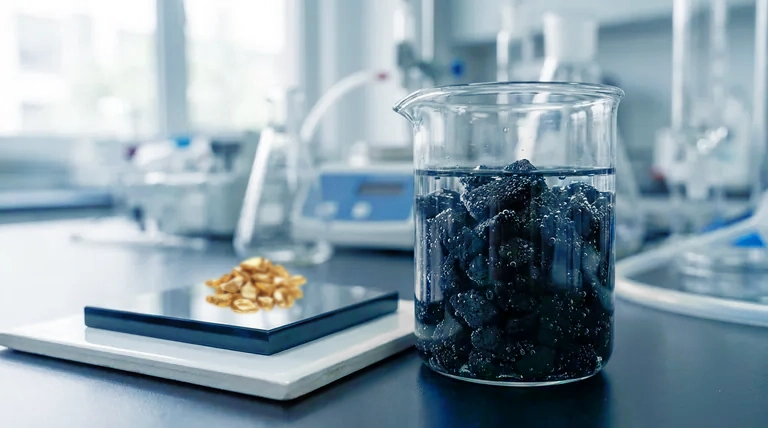
Gold recovery efficiency depends on the coordinated performance of several stages within the metallurgical process. Pre-alkalization, cyanidation, and adsorption onto activated carbon must work together to support a stable, safe, and high-performing operation.
Traditionally, lime and other alkaline reagents are used during pre-alkalization to raise the slurry pH and establish the conditions required for cyanidation. Although this approach is well established in the mining industry, operators continue to seek technologies that can improve process efficiency, reduce reagent consumption, and enhance overall leaching performance.
ExtracTech was developed in response to this need. The biopolymer is applied during the pre-alkalization stage and can be dosed directly into a plant’s existing systems without requiring changes to the operating circuit.
The technology can reduce cyanide consumption by up to 35% and require up to 20 times less alkalizing agent, helping lower operating costs while supporting more efficient gold leaching.
However, whenever a new reagent is introduced into a leaching circuit, its compatibility with downstream recovery stages must be carefully evaluated. One of the main questions raised by mining operators is whether a biopolymer could affect the kinetics or efficiency of gold adsorption onto activated carbon.
This concern is understandable. Polymers are often associated with viscous materials that may coat surfaces and potentially reduce the adsorption capacity of activated carbon.
To address this question, a study was conducted to determine whether ExtracTech affects the kinetics or efficiency of gold adsorption onto both new and regenerated activated carbon.

How ExtracTech’s Influence on Activated Carbon Adsorption Was Evaluated
Study Objective
The objective of the study was to confirm that ExtracTech, when used as an additive in the gold-leaching process, does not negatively affect the kinetics or efficiency of gold adsorption onto activated carbon.
Two conditions commonly encountered in mining operations were evaluated:
- New activated carbon
- Regenerated activated carbon
Test Method
Gold adsorption kinetic tests were conducted using a standard solution containing 10 ppm of gold. This controlled approach made it possible to evaluate the interaction between ExtracTech and each type of activated carbon.
Each experimental condition was tested in duplicate, for a total of:
- Two control tests
- Two tests containing ExtracTech
The results presented in this article represent the average of the two tests conducted under each condition.
The main experimental conditions were:
- Standard solution containing 10 ppm of gold
- Solution volume of 1 litre
- pH of approximately 10.2
- NaCN concentration of 240 ppm
- Continuous agitation
- Sampling after 1, 2, 4, 8, 16, and 24 hours
The study evaluated:
- Gold adsorption kinetics
- Gold adsorption efficiency
Results with New Activated Carbon
The first stage of the assessment was conducted using new activated carbon.
The results showed that ExtracTech did not negatively affect gold adsorption kinetics compared with the control. After the first hour, both systems had already achieved adsorption efficiencies above 94%. By the end of the 24-hour test, adsorption exceeded 99% in both conditions.
Table 1. Average gold adsorption using new activated carbon, based on two tests per condition
| Evaluation Time | Control Average | ExtracTech Average |
| 1 hour | 94.59% | 95.30% |
| 2 hours | 96.03% | 97.10% |
| 4 hours | 96.39% | 96.97% |
| 8 hours | 97.94% | 98.65% |
| 16 hours | 99.24% | 99.67% |
| 24 hours | 99.43% | 100.00% |
At every sampling point, the system containing ExtracTech produced adsorption values equal to or slightly higher than those of the control. After 24 hours, the ExtracTech condition reached 100% average adsorption, compared with 99.43% for the control.
These results indicate that ExtracTech did not reduce the adsorption capacity of the new activated carbon under the conditions evaluated.
Results with Regenerated Activated Carbon
The same methodology was then applied using regenerated activated carbon, which is widely used in industrial gold-recovery circuits.
As observed with new activated carbon, the ExtracTech condition showed an overall adsorption profile comparable to that of the control throughout the evaluation.
Table 2. Average gold adsorption using regenerated activated carbon, based on two tests per condition
| Evaluation Time | Control Average | ExtracTech Average |
| 1 hour | 5.72% | 16.86% |
| 2 hours | 18.79% | 20.13% |
| 4 hours | 30.06% | 33.12% |
| 8 hours | 46.48% | 43.89% |
| 16 hours | 60.40% | 62.18% |
| 24 hours | 68.00% | 74.08% |
Small differences were observed at individual sampling points. According to the technical report, one of the tests displayed an isolated deviation from the expected trend during the initial sampling period. This behaviour was attributed to analytical or sampling variability rather than to the presence of the biopolymer.
Despite this variability, the ExtracTech condition maintained a consistent adsorption profile. Its average result was higher than the control at five of the six sampling points, with a slightly lower result recorded at the eight-hour mark.
At the end of the test, the ExtracTech condition achieved an average adsorption efficiency of 74.08%, compared with 68.00% for the control. This represents a difference of 6.08 percentage points.
The study was designed to assess compatibility rather than establish statistically significant performance superiority. The results therefore support the conclusion that ExtracTech does not negatively affect adsorption kinetics or efficiency. The higher final adsorption value observed with regenerated carbon is also a positive result that may warrant further investigation under plant-specific operating conditions.
What Do the Results Show?
The findings directly address one of the main questions surrounding the use of ExtracTech in gold leaching: the biopolymer does not have a negative effect on the kinetics or efficiency of gold adsorption onto activated carbon.
With new activated carbon, the system containing ExtracTech achieved adsorption values equal to or slightly higher than those of the control at every sampling point. It reached 100% average adsorption after 24 hours.
With regenerated activated carbon, the ExtracTech condition maintained an overall performance profile comparable to the control. Although some variation was observed between sampling points, the system containing the biopolymer completed the test with an average adsorption efficiency 6.08 percentage points higher than the control.
Taken together, the results demonstrate that ExtracTech preserves the performance of activated carbon adsorption under the conditions evaluated. The biopolymer can therefore be incorporated into the leaching circuit without negatively affecting this critical downstream stage of gold recovery.
Conclusion
The study demonstrates that ExtracTech can be used in the gold-leaching process without negatively affecting the kinetics or efficiency of gold adsorption onto activated carbon.
In tests conducted with both new and regenerated activated carbon, the biopolymer delivered performance comparable to the control. The results confirm that its presence does not impair the carbon’s ability to adsorb gold under the evaluated test conditions.
This technical evidence supports the compatibility of ExtracTech with gold-leaching circuits that use activated carbon for gold recovery. Mining operations can therefore pursue the technology’s potential benefits—including reductions of up to 35% in cyanide consumption and the use of up to 20 times less alkalizing agent—without compromising adsorption performance.
 English
  Português do Brasil
  Español
  العربية
  Français
  Italiano