
Control del polvo en carreteras sin asfaltar: cuándo empezar y cómo elegir la mejor solución

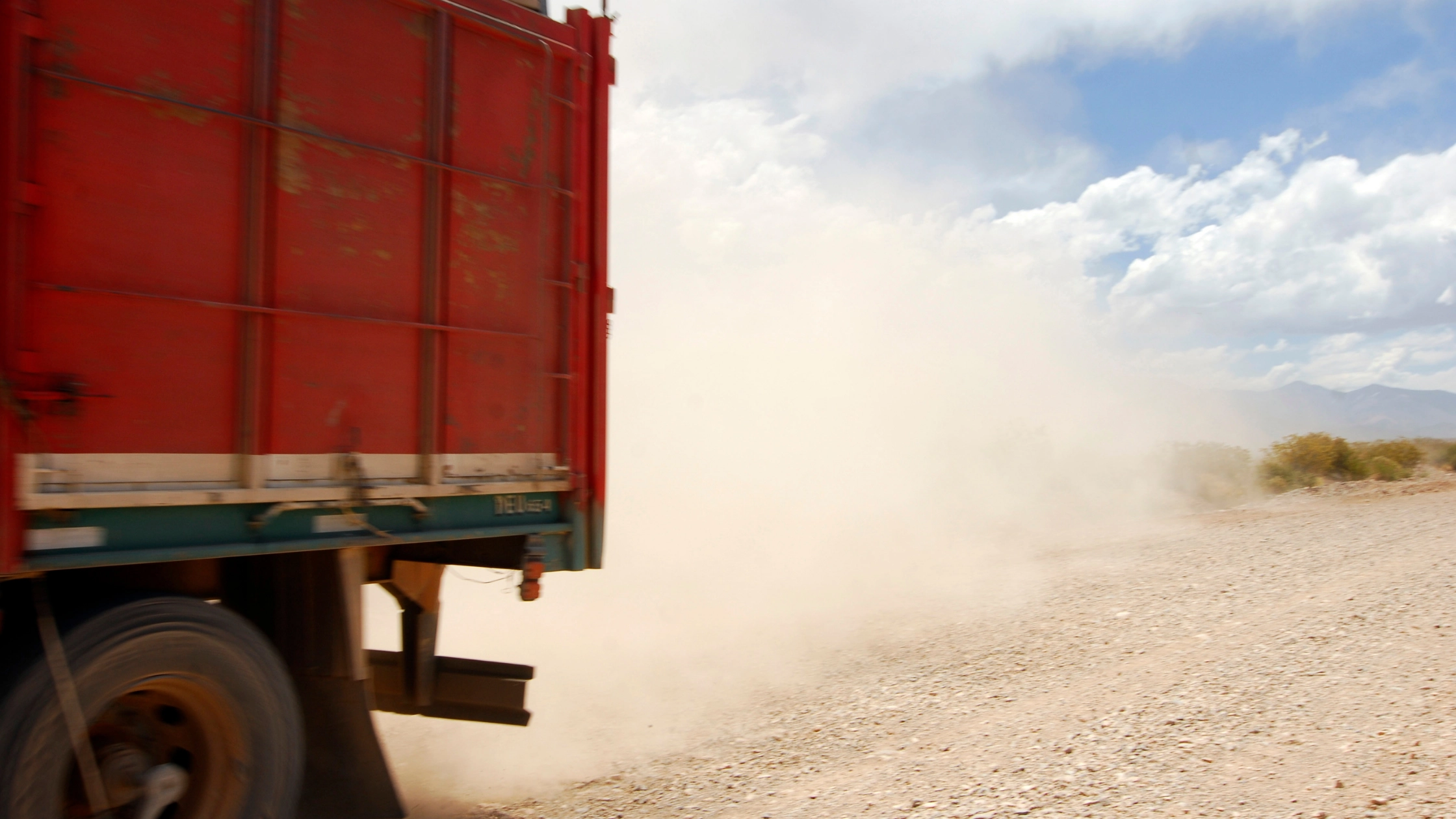
Las nubes de polvo levantadas por el tráfico de vehículos son una vista común en caminos rurales, vías de acarreo, rutas de acceso a minas y otras vías operativas. Con el movimiento de automóviles, camiones y equipos pesados, el polvo denso en el aire puede convertirse rápidamente en parte de las operaciones diarias.
Este polvo está compuesto de partículas en suspensión, que significa partículas sólidas finas que se desprenden de la superficie de la carretera y permanecen suspendidas en el aire debido a la acción del tráfico y el viento.
En caminos sin pavimentar, este tipo de emisión se clasifica como emisiones de polvo fugitivo, lo que significa emisiones difusas sin un punto fijo de control, un desafío común en minería, logística, y proyectos de infraestructura.
La generación de polvo está directamente relacionada con la pérdida de cohesión entre las partículas del suelo superficial, lo que las hace más susceptibles a desprenderse.
En zonas de tráfico intenso o próximas a comunidades, el polvo se convierte en algo más que una molestia. Representa riesgos para salud respiratoria y cardiovascular.
También hay implicaciones directas para seguridad vial, ya que la visibilidad reducida puede crear condiciones de niebla y aumentar los riesgos de accidentes.
Las partículas en el aire también pueden adherirse a componentes mecánicos, acelerando el desgaste del equipo y aumentando los costos de mantenimiento.
¿Qué son las PM10 y las PM2.5?
No todo el polvo es igual. Materia particulada se clasifica principalmente por el tamaño de partícula, siendo las fracciones más relevantes PM10 y PM2.5.
PM10
PM10 se refiere a partículas con un diámetro de hasta 10 micrómetros, comúnmente encontradas en caminos sin pavimentar, vías de acarreo, y entornos de minería.
- Puede alcanzar el tracto respiratorio superior
- También pueden llegar a los pulmones
- Asociado con exposición al polvo en operaciones viales
PM2.5
PM2.5 consiste de partículas aún más finas, con diámetros de hasta 2.5 micrómetros.
- Penetra más profundamente en el sistema respiratorio
- Asociado con más severo impactos en la salud
- Relevante para gestión de la calidad del aire
En la práctica, supresión de polvo se centra en la reducción de las emisiones de ambos PM10 y PM2.5, mejorando calidad del aire y el apoyo al cumplimiento medioambiental.

Control de polvo y licencias de operación
Control de polvo no solo es una buena práctica operativa, sino también un requisito en muchas licenciamiento ambiental, especialmente en cuanto a control de emisiones atmosféricas.
Empresas en sectores como:
- Minería
- Agroindustria
- Logística
- Infraestructura
debe demostrar eficacia medidas de supresión de polvo para obtener y mantener su licencia de operación.
Las emisiones excesivas de partículas pueden resultar en:
- Incumplimiento de las condiciones del permiso ambiental
- Multas y sanciones regulatorias
- Restricciones o suspensión de operaciones
- Aumento de quejas de comunidades cercanas
La adopción de soluciones eficaces de control de polvo ayuda a mitigar los riesgos regulatorios y a garantizar la continuidad operativa.
Cuando el problema empeora
En algunas regiones, las condiciones secas persisten durante todo el año. En otras, son estacionales.
- En climas secos constantes, control de polvo debe ser continuo
- En las regiones de temporada, la planificación debe comenzar antes del período seco.
En momento de aplicación es uno de los factores más críticos para lograr una supresión de polvo eficaz, y a menudo se pasa por alto.
Prácticas actuales de control de polvo
El método más común es el uso de camiones cisterna para aplicar humedad a la superficie de la carretera.
Sin embargo, este método tiene limitaciones:
- Baja eficiencia
- Duración corta debido a la evaporación
- Alta frecuencia de reaplicación
Lo que lleva a un aumento de:
- Consumo de agua
- Consumo de combustible
- Costos operativos
Otros Métodos de Control de Polvo
- Cloruro de calcio y cloruro de magnesio agentes higroscópicos
- Lignosulfonatos unión superficial temporal
- Emulsiones asfálticas sellado de superficies
- Polímeros sintéticos
Limitaciones de los métodos tradicionales
- Alto costo logístico
- Reaplicaciones frecuentes
- Riesgos ambientales
- Bajo rendimiento bajo tráfico intenso
- Dificultad en lograr una aplicación uniforme
Supresión de polvo con biopolímero
En MetaFLO, desarrollamos DusTech, a biopolímero derivado de algas marinas que realza estabilización superficial del suelo.
Los beneficios clave incluyen:
- Cohesión de partículas aumentada
- Desprendimiento reducido de finos
- Menor emisión de partículas (PM10 y PM2.5)
Después del curado, el producto forma una matriz superficial estabilizada que:
- Resistente al impacto del tráfico
- Mantiene el rendimiento en condiciones climáticas adversas

Ventajas Operativas
- Seguridad medioambiental
- Sin riesgo para la fauna terrestre
- Fácil aplicación con camiones cisterna
- No es necesario premezclar
- No se necesita equipo adicional
- Liberación inmediata del tráfico tras la aplicación
Resultados Operacionales Reales
- Aumento del intervalo de humectación de 2 horas a hasta 18 horas
- Reducción de 6 a 2 camiones de agua por día
- Reducción del consumo de agua de hasta 67%
- Reducción del consumo de combustible de hasta 76%
Además, el producto proporciona un efecto residual, mejorando el rendimiento a largo plazo y reduciendo la frecuencia de reaplicación.
Cómo elegir la mejor solución de control de polvo
La solución ideal de control de polvo depende de:
- Volumen de tráfico
- Tipo de suelo
- Distribución del tamaño de partícula y contenido de finos
- Condiciones climáticas
- Disponibilidad de agua
- Requisitos ambientales y regulatorios
Las soluciones de solo agua pueden funcionar en casos específicos, pero generalmente son ineficientes para operaciones continuas.
Tecnologías como los biopolímeros ofrecen:
- Mayor durabilidad
- Costos operativos reducidos
- Mejora del desempeño ambiental
Conclusión: el momento y el método importan
El control del polvo en caminos no pavimentados es técnicamente factible y puede ser muy eficaz.
Sin embargo, el éxito depende de:
- Elegir la tecnología adecuada para la supresión de polvo
- Iniciando la aplicación en el momento correcto
Planificando con antelación, reduciendo la dependencia del agua y adoptando estrategias más eficientes de control de polvo, es posible:
- Minimizar los impactos en la salud
- Reducir costos operativos
- Preservar el equipo
- Mejorar la seguridad vial
 English
  Português do Brasil
  Español
  العربية
  Français
  Italiano