
Les fosses de séchage de boues contre la solidification sur site : temps, espace et productivité
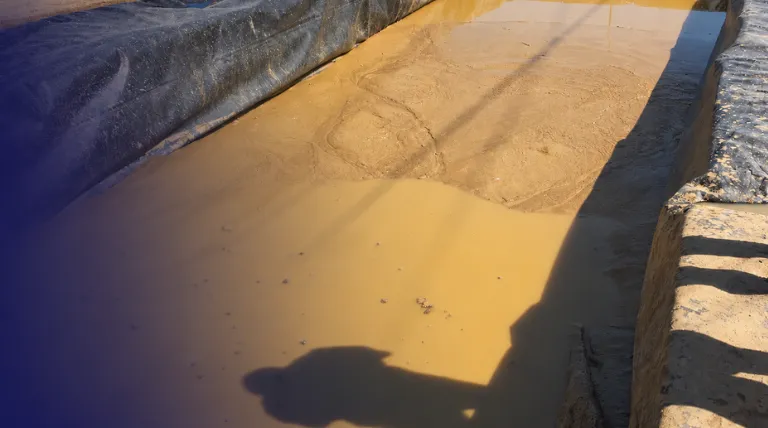
Excavation productivity depends on more than how quickly material is removed. HDD slurry, hydrovac waste and tunnel spoils also need to be managed at a pace that keeps the jobsite moving.
In suitable applications, on-site solidification can solidify wet spoils in up to 30 minutes. Natural drying, by comparison, relies on evaporation and drainage and can take days or weeks. The right approach depends on the material, site conditions, available space and project requirements.
For horizontal directional drilling (HDD), hydro excavation and tunneling contractors, the choice between slurry drying pits and on-site solidification can affect processing time, storage needs and how consistently crews coordinate excavation and material removal.
When Natural Drying Becomes an Operational Bottleneck
Slurry drying pits and ponds rely mainly on evaporation and, where drainage is available, gravity-driven water removal to reduce moisture content.
Although passive drying does not require solidification reagents, it comes with operational considerations.
Material Retention Time
Natural drying can take days or even weeks, depending on material composition and environmental conditions.
When material generation exceeds the rate at which spoils become ready for removal, a backlog can develop. Contractors may need to accommodate additional material, arrange alternative disposal methods or adjust excavation activity.
Limited Jobsite Space
Drying pits require dedicated areas that could otherwise support equipment movement, pipe storage, material staging or other construction activities.
On urban utility installations, road crossings and tunneling projects, expanding these areas may not be practical.
Dépendance météorologique
Temperature, humidity, wind and precipitation influence evaporation rates.
Rainfall can introduce additional water into exposed drying pits, extend processing time and make it harder to coordinate material removal with construction schedules.
Inconsistent Material Condition
A dry surface does not necessarily mean the full volume is ready for loading.
Slurry can develop a surface crust while retaining free water underneath. When crews disturb the material during excavation or loading, it may become flowable again and require additional handling before transportation.
How Drying Time Influences Jobsite Storage Capacity
One way to evaluate the operational impact of passive drying is to examine the relationship between material generation and retention time.
A simplified planning calculation is:
Estimated Storage Volume = Daily Spoils Generation × Material Retention Time
Consider a project generating 100 cubic yards of wet spoils per day.
| Material retention time | Estimated accumulated volume |
|---|---|
| 1 day | 100 yd³ |
| 3 days | 300 yd³ |
| 6 days | 600 yd³ |
| 14 days | 1,400 yd³ |
Illustrative calculation assuming constant material generation, no intermediate removal and no significant volume reduction.
The actual storage capacity required will also depend on drainage, rainfall, containment geometry, removal frequency and operational allowances.
Nevertheless, the relationship illustrates an important planning consideration: even when excavation output remains constant, longer retention periods can significantly increase the volume of material occupying the jobsite.
Where space is limited, reducing processing time may be more practical than expanding storage capacity.
On-Site Solidification: An Alternative to Waiting for Evaporation
Slurry solidification approaches material management differently. Instead of relying on atmospheric evaporation, a solidification reagent interacts with wet spoils to control free water and change the material’s physical consistency.
In suitable applications, MetaFLO solidification reagents can solidify wet, flowable material in up to 30 minutes, with reagent dosages below 1%. Performance depends on the material, reagent selection, dosage, mixing conditions and project requirements.
Solidification does not necessarily remove water from the material. Instead, it changes how the material retains water and improves its handling characteristics.
Depending on the application, crews can mix the reagent using excavators, loaders or dedicated dosing equipment. By shortening the processing cycle, contractors may be able to use a smaller, short-cycle mixing and handling area instead of relying on long-term drying space.
The process also reduces reliance on favorable weather during material processing. However, appropriate storage and weather management practices remain necessary.
Passive Drying vs. On-Site Solidification
| Operational factor | Passive drying | Solidification sur place |
|---|---|---|
| Temps de traitement | Days to weeks | Up to 30 minutes* |
| Water management | Evaporation and drainage | Control of free water and change in material consistency |
| Space requirements | Extended drying and storage areas | Short-cycle processing areas |
| Weather dependency | Haut | Reduced during processing |
| Material consistency | May vary throughout the drying area | Managed through reagent selection, dosage and mixing |
| Operational planning | Processing time can vary | Shorter, more predictable processing cycles |
*Performance depends on material characteristics, reagent selection, dosage, mixing conditions and project requirements.
Field Application: From Days of Drying to 30 Minutes
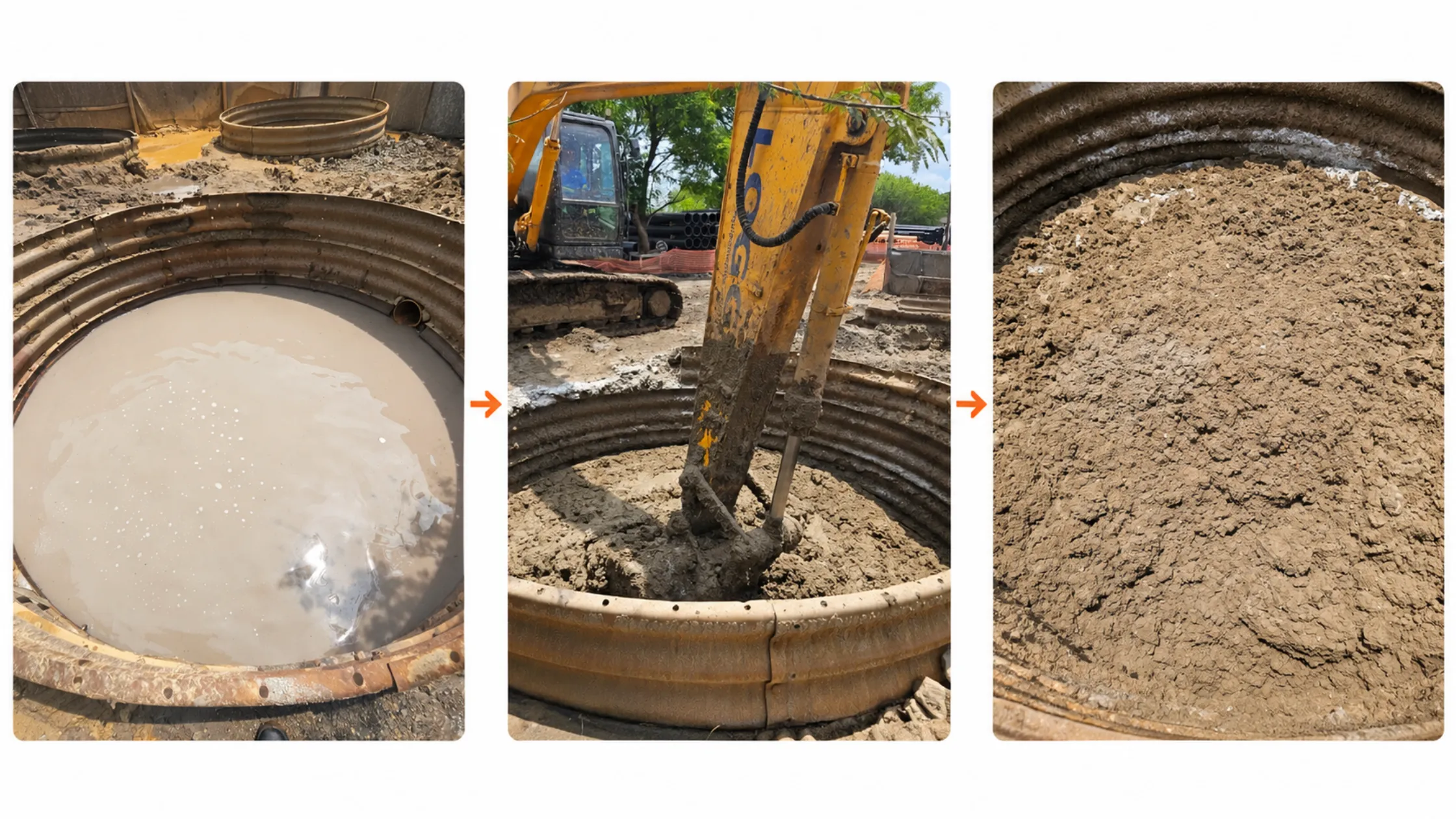
In one Fonctionnement du disque dur, natural drying required between 6 and 14 days before drilling spoils could be prepared for transportation.
The project generated approximately 330 m³ of material per week, with around 470 m³ accumulated on-site. The material had a moisture content of approximately 45%.
Using MetaFLO’s MF003 solidification reagent and an excavator already available on-site, the contractor solidified the material to a manageable consistency suitable for loading in approximately 30 minutes.
For an operation generating hundreds of cubic meters of material each week, shortening the time needed to prepare spoils for transportation can help reduce backlog and improve the use of available jobsite space.
The application also shows how HDD slurry solidification can fit into an existing operation without necessarily requiring additional specialized mixing equipment.
How Liquid Waste Solidification Supports HDD, Hydro Excavation and Tunneling
The operational value of solidification depends on how each industry generates, handles and removes excavated material.
Forage horizontal directionnel (HDD)
After drilling fluid recovery or recycling, residual drilling mud and wet spoils still require management. Solidification sur place can reduce reliance on drying pits, particularly when temporary storage is limited or needs to be cleared before crews move to the next drilling location.
Hydro Excavation
For hydrovac contractors and receiving facilities, shorter processing cycles can support faster material turnover and help manage incoming hydravac without prolonged accumulation in drying or holding areas.
Tunnels
In EPB-TBM operations, material management must accommodate the rate at which conditioned tunnel muck is discharged. Solidification can help achieve the consistency required for truck loading or temporary storage in muck cells.
In slurry TBM applications, suitable reagents may also be considered for residual wet solids after separation.
Selecting a Solidification Solution for the Material
Material composition, moisture content, clay characteristics, drilling fluid additives and available mixing equipment all influence reagent selection.
With more than 22 years of experience in solidification, MetaFLO Technologies offers a portfolio of granular, powder, biodegradable and liquid reagents, including formulations for regional and project-specific requirements.
Material characterization and dosage testing can help identify an appropriate formulation and establish processing parameters before field implementation.
Receiving-facility requirements also need to be considered. Where applicable, EPA Method 9095B, the Paint Filter Liquids Test, can assess the presence of free liquids. However, passing this test does not determine waste classification, regulatory compliance or facility acceptance; those are separate considerations.
Material Management Is Part of Excavation Productivity
Increasing excavation capacity does not necessarily improve overall project productivity if the resulting material cannot be managed at a corresponding rate.
When comparing passive drying with on-site solidification, contractors should consider processing time, available storage space, weather conditions and coordination between excavation and material removal.
For projects facing space constraints, variable weather or demanding production schedules, shorter processing cycles can offer a more predictable approach to wet spoils management.
The speed of excavation should not be limited by the speed of natural drying.
Questions fréquemment posées
How long does on-site solidification take?
In suitable applications, MetaFLO solidification reagents can solidify wet spoils in up to 30 minutes. Actual processing time depends on the material, reagent dosage and mixing conditions.
Does solidification dry the material?
Not necessarily. Solidification changes how water is retained in the material and helps control free water. It does not always remove water through evaporation or dewatering.
Can solidification replace a slurry drying pit?
It may reduce reliance on long-term drying areas by shortening the processing cycle. The best approach depends on the material, site layout, operational requirements and receiving-facility criteria.
Does solidified material automatically meet disposal requirements?
No. Material handling characteristics and acceptance requirements are separate. Waste classification, regulatory compliance and receiving-facility acceptance must be assessed for each project.
Could Your Current Drying Process Be Limiting Productivity?
Share your daily spoils volume, current drying time and material characteristics with MetaFLO’s specialists. Our team can help assess whether on-site solidification could improve your material management cycle.
Phone: 1-888-862-4011
Courriel : [email protected]
 English
 Português do Brasil
 Español
 العربية
 Français
 Italiano
 Deutsch