
SoilTech Powers Sustainable Railway Backfill Layer

The use of MetaFLO’s biopolymer resulted in notable cost savings, productivity gains, and environmental benefits for a large-scale railway project by speeding up the stabilization process while cutting down water usage.
Location
Alto Horizonte, GO, Brazil
Challenge
Conventional methods for regularizing railway backfill layers are resource-heavy, even when dealing with soils like silt that contain high levels of iron oxide. These techniques often rely on substantial water usage, leading to high operational costs and extended project timelines. To overcome these issues, there was a need for a more sustainable and cost-effective solution that could rapidly stabilize the soil while staying within budget and meeting project deadlines.
Solution
In this study, MetaFLO applied 0.01% of SoilTech biopolymer to a 280x12x0.35 m3 track, to demonstrate the technology’s potential for road stabilization. When diluted directly in a water truck and applied to the track, SoilTech binds with the soil, forming a hydrogel while improving the soil’s mechanical properties after it cures. The treated soil exhibited increased mass density, better compaction, enhanced layer stabilization, and improved impermeability.
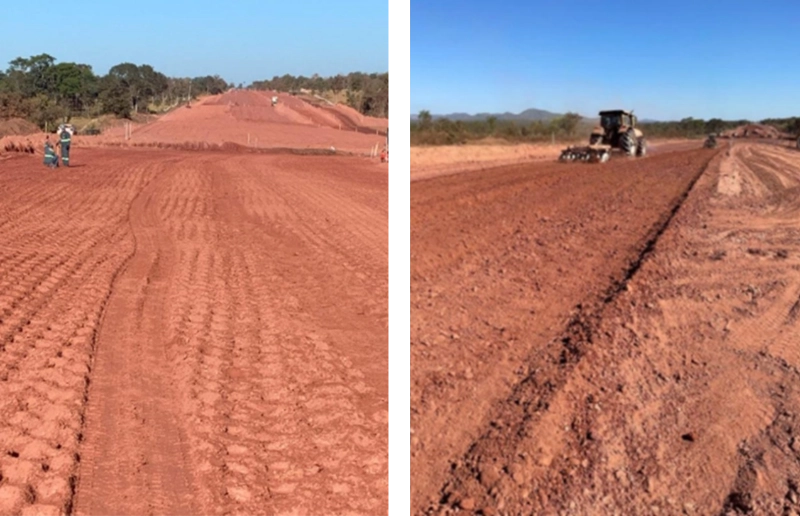
Before and After
Outcome
✓ COST SAVINGS
Besides being much more environmentally friendly than traditional backfill regularization methods, SoilTech reduced fuel consumption and emissions of polluting gases by 35%, and workforce labor time by 2 hours—resulting in total cost savings of 43%.
✓ WATER SAVINGS
The use of SoilTech made it possible to reduce water consumption by 50%, saving a total of 60,000 litres of water throughout this project.
✓ ROAD QUALITY
24 hours after curing, the soil displayed enhanced particle cohesion, improved compaction, and increased impermeability, leading to a more durable and resilient road surface.
 English
  Português do Brasil
  Español
  العربية
  Français
  Italiano